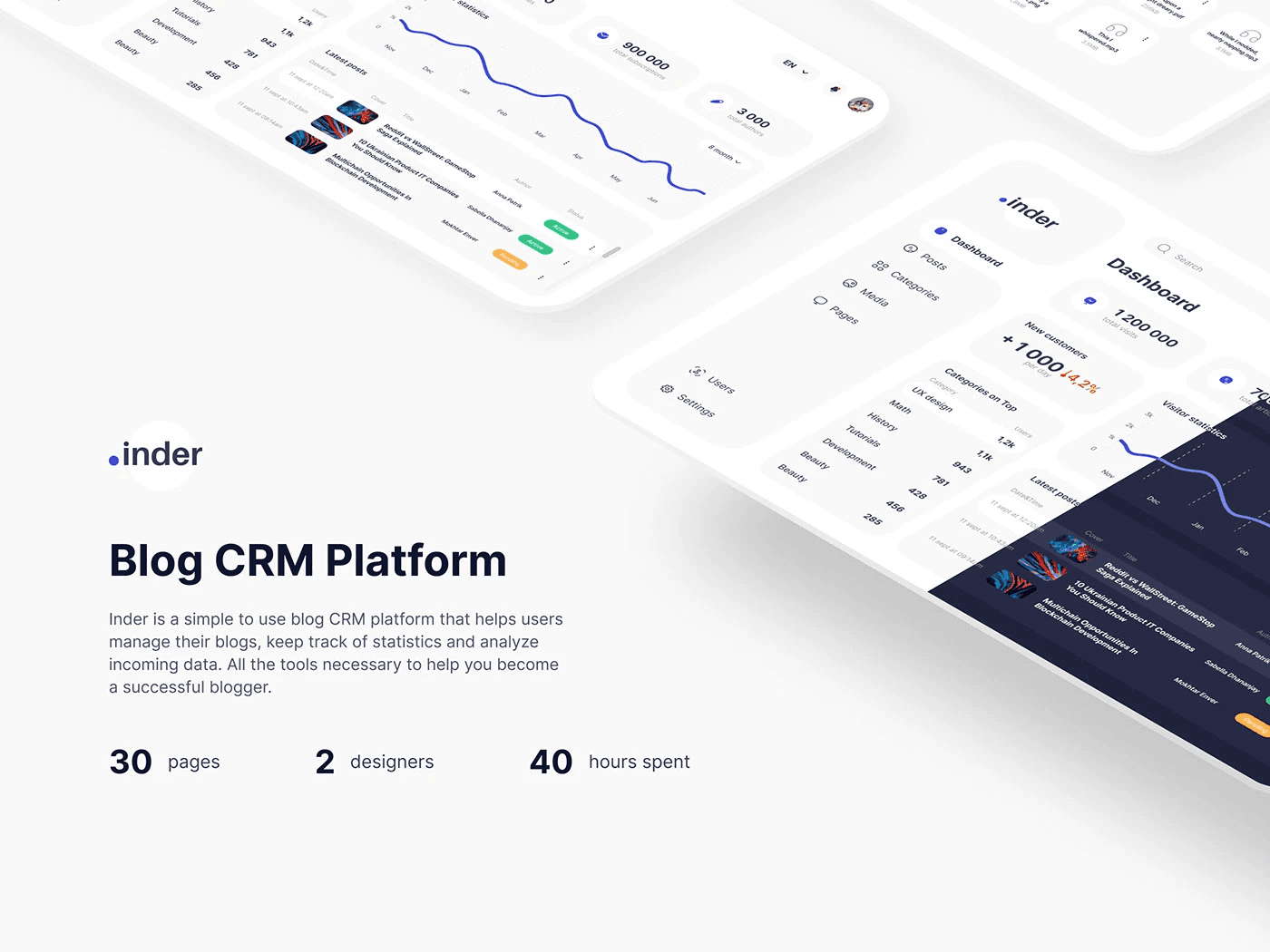
Inder is a blog CRM platform purpose-built for the challenges of modern content creation. While most bloggers today are proficient at writing, they are poorly served by the tools available to them — forced to juggle separate platforms for publishing, audience analytics, media management, and reader engagement. The result is fragmented workflows, missed insights, and time spent on administration rather than content.
The Inder team came to us with a clear brief: design a platform that consolidates every function a blogger needs into one coherent, intuitive system — without the bloated complexity that makes enterprise CMS tools unusable for solo creators and small teams. The goal was to serve bloggers at every level, from independent writers to professional publishing operations, through a single, scalable interface.
Our scope covered the full product design process — UX research, information architecture, interface design, component system, and development handoff — alongside web and mobile implementations of the platform.
Scope
UI/UX Design, Web Development, Mobile Development. The project covered the full product lifecycle from discovery through to a responsive web platform and a cross-platform mobile application.
The Core Problem
Bloggers were managing their content, analytics, and audience across three to five separate tools — each with its own learning curve and subscription cost. The absence of a unified system was costing creators both time and meaningful insight into their own audience behaviour.
Design Recognition
The Inder platform was recognised with a Behance Award following publication, with the design community acknowledging the platform's visual clarity, structural depth, and the quality of its component architecture.
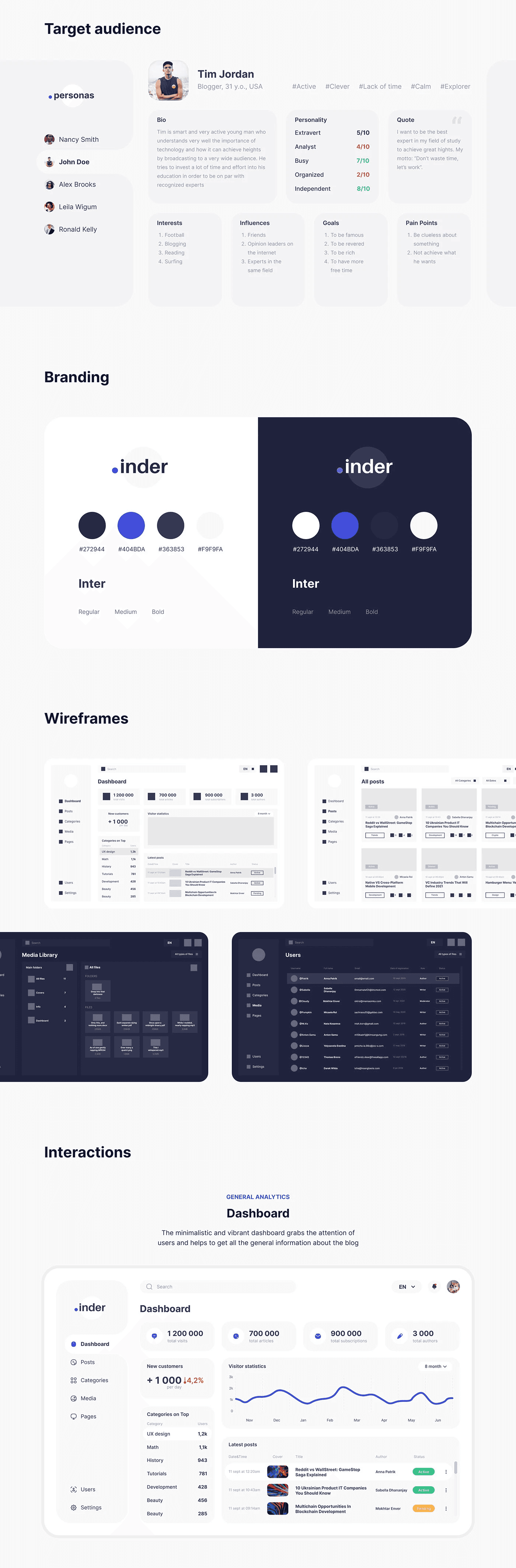
Before a single frame was designed, we conducted structured research into the blogging community's real pain points. Four distinct challenges emerged as the foundation of every design decision that followed.
Challenge 01
Fragmented Management Workflows
Bloggers consistently reported the need for a single application that could handle every dimension of their operation intuitively. The market offered either oversimplified tools or enterprise-grade platforms with steep learning curves — nothing in between that served the serious independent creator.
Challenge 02
Cost of Maintaining Multiple Subscriptions
The total cost of assembling a functional stack — a CMS, an analytics tool, a media library, and an audience management system — was prohibitive for most independent bloggers. There was a clear market need for a consolidated solution that eliminated redundant tooling without sacrificing capability.
Challenge 03
Lack of Actionable Performance Insight
Existing analytics tools provided data, but not clarity. Bloggers could see page views but struggled to understand which content was driving meaningful reader engagement, what publishing patterns were working, and how to translate data into actionable content strategy.
Challenge 04
Accessibility Across Technical Skill Levels
Any solution had to serve both technical and non-technical users equally well. A creator who understands code should not be penalised by a simplified interface; a writer with no technical background should not be blocked by unnecessary complexity. The design had to accommodate both without compromise.
A four-phase process was followed to move from research findings to a production-ready, scalable platform — with each phase building directly on the outputs of the last.
Phase 01 — Research & Planning
Market Research & Problem Definition
We mapped the competitive landscape of blogging and content management tools, interviewed bloggers across experience levels, and synthesised the findings into a set of clearly defined design principles. The research confirmed that fragmentation — not any single missing feature — was the core problem to solve. Every subsequent decision was tested against this finding.
Phase 02 — Design & Prototyping
Interface Design & Visual System
We designed a clean, modern interface that prioritises information density without visual complexity. The component system was built for consistency and scalability — structured so that the platform could grow in feature scope without accumulating design debt. Prototypes were tested against both technical and non-technical user profiles before any development work began.
Phase 03 — Implementation
Web & Mobile Development
The platform was developed across web and mobile, with a responsive architecture that maintains full functionality regardless of device. Structured components were built to support the platform's core functions — post management, analytics dashboards, media library, and audience tools — with clear API boundaries to allow future feature expansion.
Phase 04 — Testing & Optimisation
Cross-Device Testing & Refinement
Comprehensive testing was conducted across devices, browsers, and user profiles. Interactions, information hierarchies, and loading states were refined based on feedback — with particular attention to the analytics views and the post editor, where usability friction had the greatest impact on the overall experience.
Inder brings publishing, analytics, media management, and audience tools under one roof — giving bloggers at every level the operational clarity they need to focus on content rather than tooling.
Unified Post Management
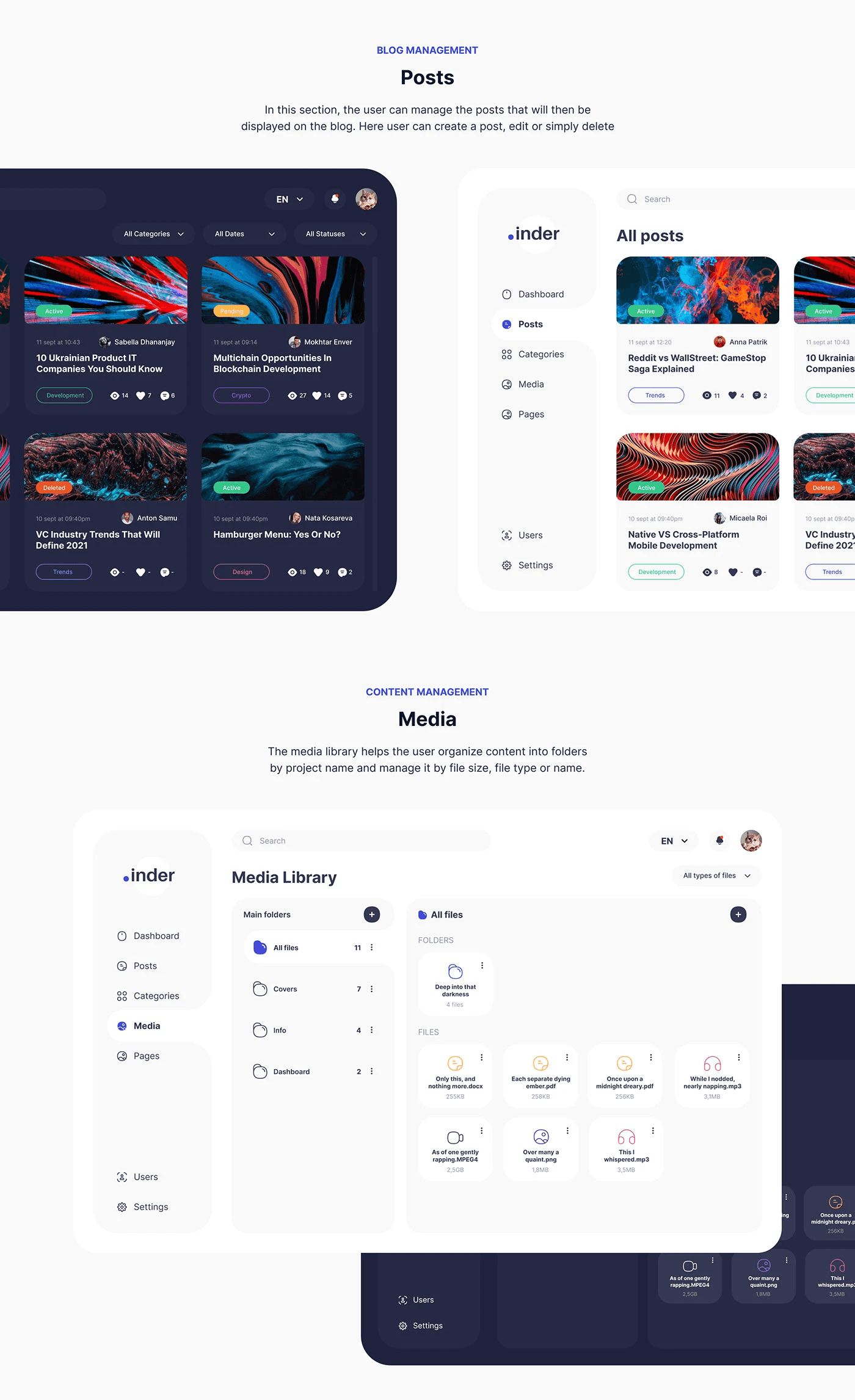
A full-featured editor with scheduling, status management, tagging, and SEO metadata — giving creators complete control over their publishing pipeline from a single workspace, without switching between tools.
Integrated Analytics
Performance data presented in context — not raw numbers, but structured insight into which content drives engagement, when readers are most active, and what publishing patterns produce the strongest results.
Structured Media Library
A centralised asset repository that allows creators to categorise, tag, and retrieve media efficiently — eliminating the disorganised folder systems that slow down content production at scale.
Audience Management
Tools for monitoring reader interactions, segmenting audiences, and managing user relationships — giving bloggers the capability to build and maintain an engaged community directly within the platform.
Accessible by Design
The interface was designed to serve both technical and non-technical users without compromise — complex data presented clearly, and advanced controls available without cluttering the baseline experience.
Scalable SaaS Architecture
Built as a scalable SaaS platform, Inder's architecture supports individual bloggers and growing content teams on the same codebase — allowing the product to expand in scope without a redesign.
Outcome 01
Significant Reduction in Workflow Overhead
Bloggers using the platform reported meaningful time savings from consolidating their management needs into a single tool. Time previously spent switching between applications — writing tools, analytics dashboards, and media folders — was redirected toward content creation and audience strategy.
Outcome 02
Measurable Improvement in Blog Performance
Users who engaged consistently with Inder's analytics module reported direct improvements in content performance. Having reader engagement data structured and accessible within the same platform where they publish made it significantly easier to iterate on content strategy with confidence.
Outcome 03
Behance Award — Design Excellence
Following publication, the Inder platform received a Behance Award in the UI/UX category. The recognition acknowledged the platform's visual quality, structural coherence, and the accessibility of its interface across the full range of intended users — from beginner bloggers to professional publishing teams.